
Find Maryland Divorce Records
Maryland divorce records are public documents filed at the Circuit Court in the county where the divorce was granted. Each of Maryland's 24 jurisdictions, including Baltimore City which operates as its own court system separate from Baltimore County, keeps its own divorce case files. You can search basic case information for free through the Maryland Judiciary Case Search portal at no cost. Certified copies of divorce decrees come from the Clerk of the Circuit Court in the county where the case was filed. For divorces granted since 1992, the Division of Vital Records also issues verification certificates. This guide covers how to find and request Maryland divorce records from every available source.
Maryland Divorce Records Overview
Where to Find Maryland Divorce Records
Three main sources hold Maryland divorce records. The Circuit Court Clerk in each county keeps the full case file for every divorce filed in that jurisdiction. These files go back to 1854 in most Maryland counties. Baltimore City divorce records go back further, though files before 1982 are now held only at the Maryland State Archives. The Clerk's office can provide plain copies or certified copies of any document in the file. You can visit in person, send a written request by mail, or in several counties send a request by email.
The free Maryland Judiciary Case Search at casesearch.courts.state.md.us is the fastest starting point for looking up divorce cases across all Maryland Circuit Courts. It shows basic case data: party names, case number, filing date, case type, and scheduled hearings. Two case type codes are used for divorce records in Maryland. DA stands for absolute divorce, which fully ends the marriage. DL stands for limited divorce, which is a legal separation where the parties remain married. The portal does not show actual document images. To get a copy of the decree or any paper in the case file, you must contact the Circuit Court Clerk directly.
The Maryland Division of Vital Records issues divorce verifications for cases finalized on or after January 1, 1992. This is a certificate, not a copy of the decree. It confirms the divorce happened and includes names and the date, but it does not contain the settlement terms. For historical records that predate the early 1990s, the Maryland State Archives holds transferred court files and online indexes for most counties.
How to Search Maryland Divorce Records
Start with the Maryland Judiciary Case Search if you want basic information free. Go to casesearch.courts.state.md.us, accept the terms, then choose Civil Case as the case type and Circuit Court Only for the court system. Select the county if you know it, or leave it open for a statewide search. Enter the name of either spouse and set a date range if you have a rough idea when the divorce was filed. Look for results labeled DA or DL to identify Maryland divorce cases in the results list.
If you do not know which county filed the divorce, the statewide name search can help narrow it down. Once you have a case number, getting the actual records from the Circuit Court Clerk goes much faster. Worth noting is that Washington County has a specific rule: since October 2020, that Clerk's Office cannot search cases by name and requires a case number for all record requests. Use the Maryland Judiciary Case Search first to find the case number before contacting them. Each county Circuit Clerk page on the Maryland Courts website also lists that county's specific procedures and contact information.
Note: The Maryland Electronic Courts system lets parties to a case view their own documents online, but public access to document images is not available through this portal.
Maryland Division of Vital Records
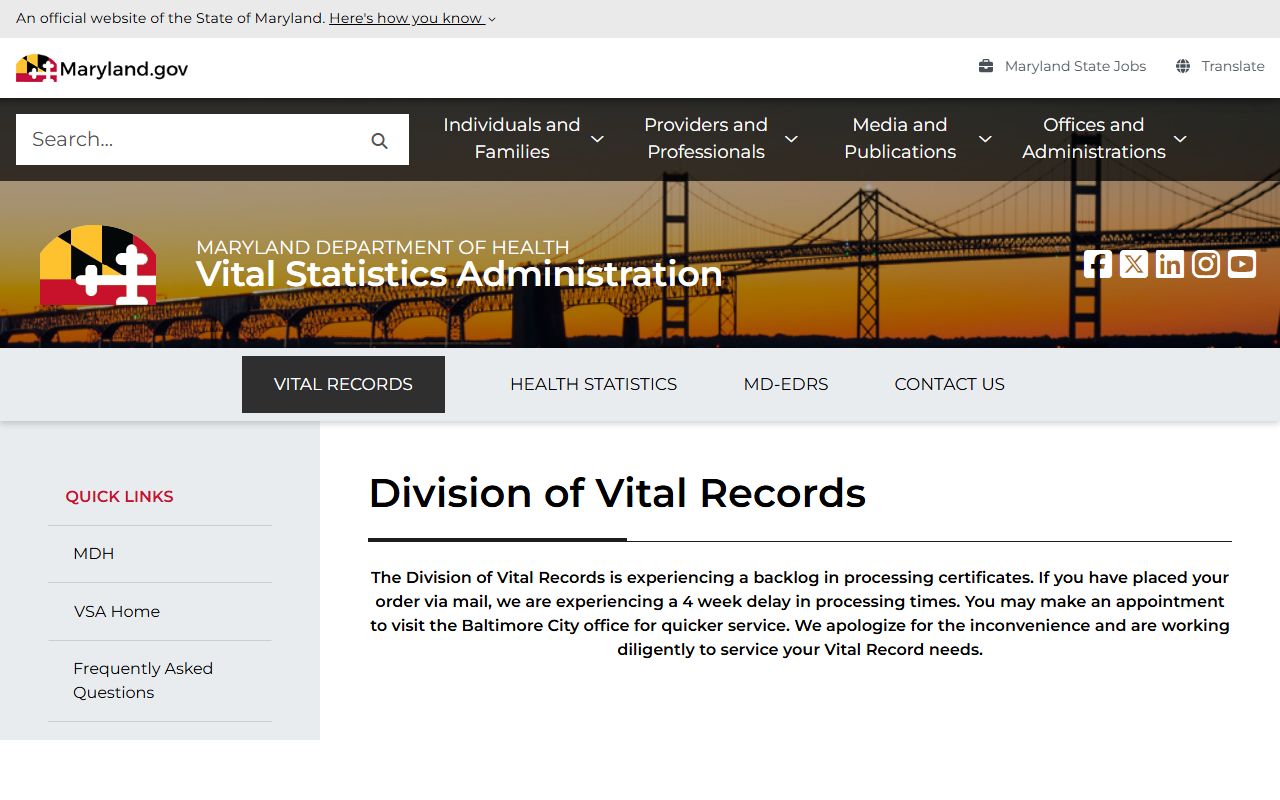
The Maryland Department of Health's Division of Vital Records has been collecting divorce data from Maryland courts since January 1, 1992. They issue verification certificates, which are not copies of decrees. A verification shows the names of both parties, the date the divorce was granted, and the county. It does not include property settlement terms, custody orders, alimony provisions, or other details from the decree itself. Many people need this type of certificate as basic proof of divorce for legal matters like remarriage or name changes.
The fee is $12 per verification. Submit a completed Application for Verification of Divorce Record with a copy of your government-issued photo ID and a check or money order payable to the Division of Vital Records. Mail to 6550 Reisterstown Road, Baltimore, MD 21215. The phone number is 410-764-3038. Processing by mail takes several weeks. If you need the full decree with all its terms and court orders, you must go to the Circuit Court Clerk in the county where the divorce was granted, not the Division of Vital Records.
Maryland State Archives and Divorce Records
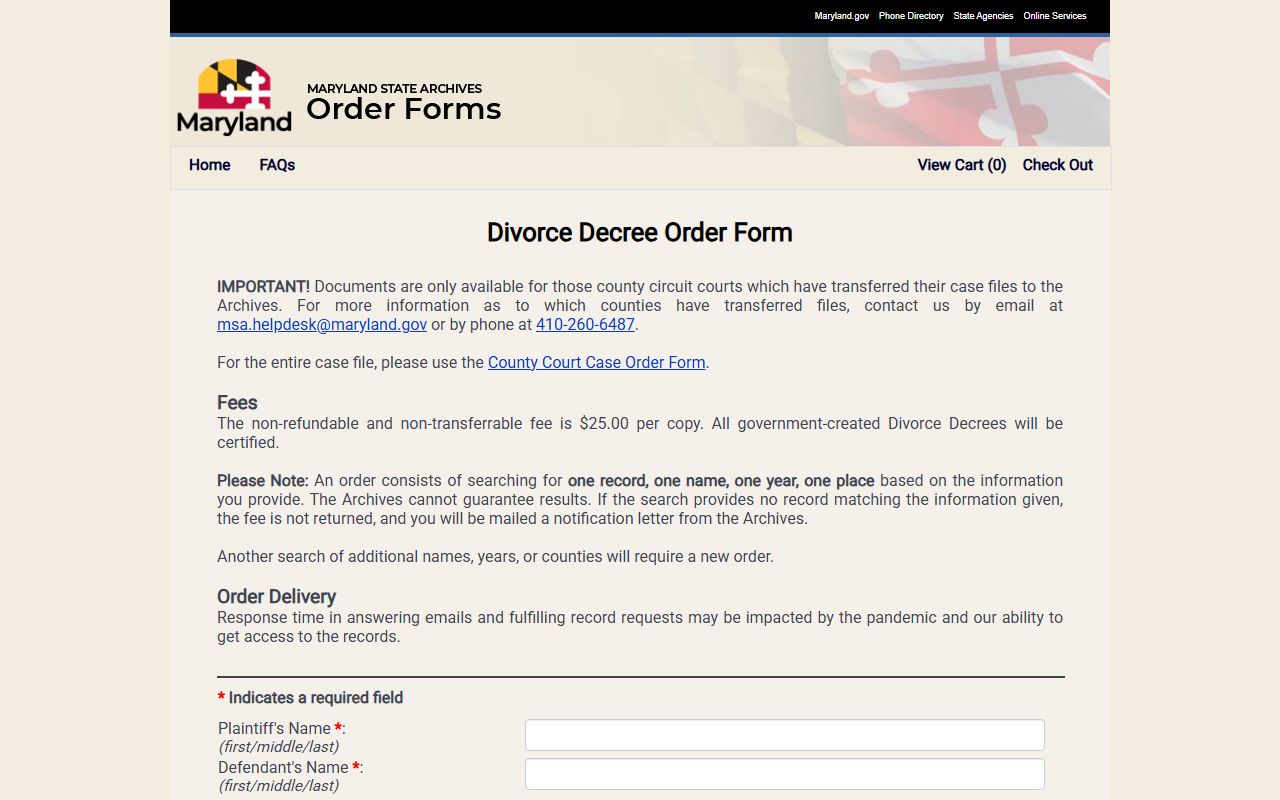
The Maryland State Archives in Annapolis holds divorce records that Circuit Courts have transferred over time. For most Maryland counties, the Archives has records going back well into the 1800s. Baltimore City divorces up to 1982 are only available at the Archives and cannot be obtained from any other source. If you are searching for an older Maryland divorce record and the Circuit Court cannot locate it, the Archives is likely where the file was sent.
You can search the Archives online index before placing an order. The research guide at guide.msa.maryland.gov links to county-level indexes for all 24 Maryland jurisdictions. When you find the case in the index, you can order copies online at shop.msa.maryland.gov. You will need the names of both parties, the county where the divorce was granted, the approximate date, and the case number if known. Certified copies cost $25. Uncertified copies run $5 or less per page depending on the record type. Mail inquiries can be sent to the Archives at 350 Rowe Boulevard, Annapolis, MD 21401, or call 410-260-6400.
Maryland Divorce Laws and Grounds
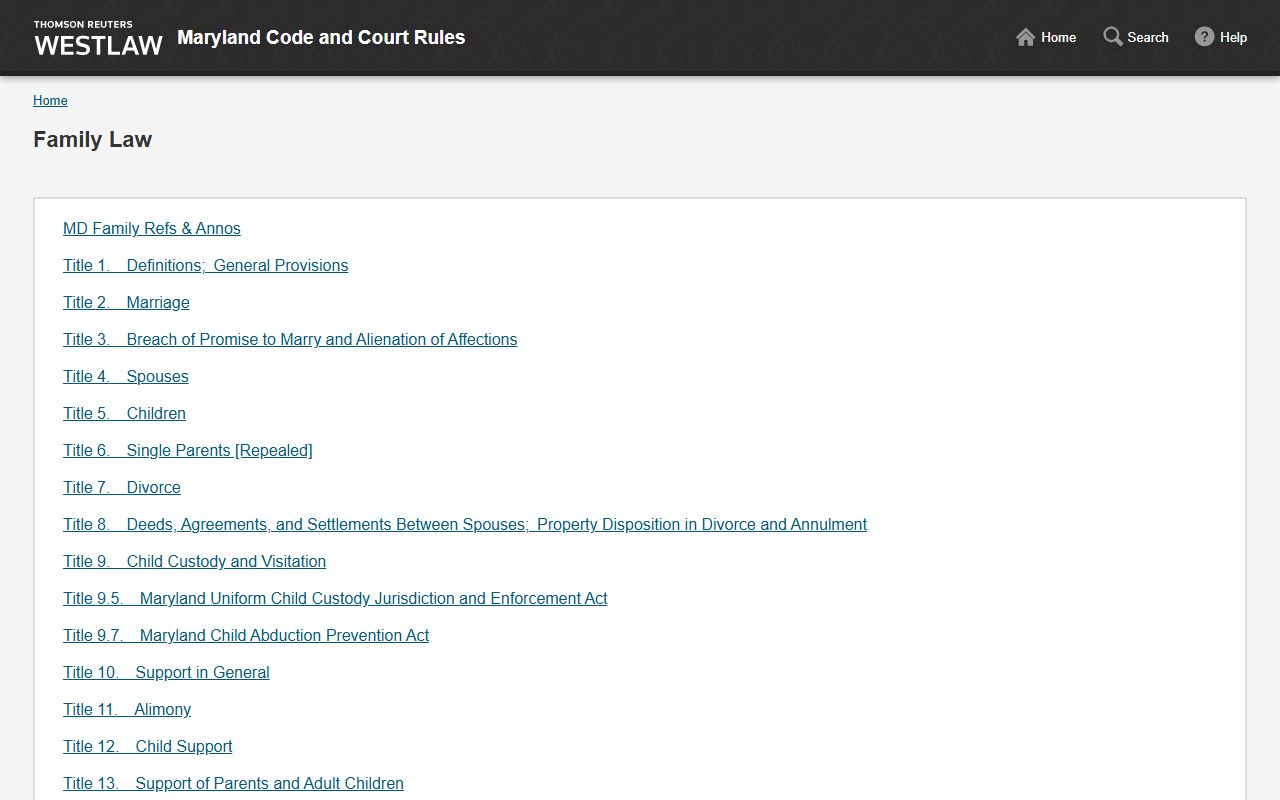
Maryland law treats marriage as a civil contract. A divorce formally ends that contract through a court order. Circuit Courts are the only Maryland courts with the authority to grant divorces, a power established under Md. Code, Family Law § 1-201, which gives Circuit Courts equity jurisdiction over divorce, alimony, and annulment. There are two kinds of divorce in Maryland. An absolute divorce fully ends the marriage. A limited divorce is a court-ordered separation where the parties remain legally married but live separately. Each type produces its own Maryland divorce records.
Residency rules are set by Md. Code, Family Law § 7-101. At least one spouse must be a Maryland resident to file. If the grounds for divorce occurred inside Maryland, current residency is enough. If they happened outside Maryland, at least one party must have lived in Maryland for at least six months before filing. You file in the county where you or your spouse currently lives.
Under Maryland Family Law Title 7, there are three grounds for an absolute divorce in Maryland. The first is six-month separation, where the parties lived separate and apart continuously before filing. Two people can share a home and still be considered separated if they pursue separate lives. The second ground is irreconcilable differences, meaning the marriage has broken down beyond repair. The third is mutual consent, which has been available since 2015. Mutual consent requires both spouses to sign a written settlement agreement that covers alimony, property division, and any child-related issues before the hearing. The court must find that the terms for any children are in their best interest.
Maryland Rule 16-902 governs public access to court records, including Maryland divorce records. Most basic case information is open to the public. Maryland Rule 16-934 requires that certain sensitive data be shielded from public copies. Social Security numbers, financial account numbers, medical and psychological records, and information about minor children must all be redacted. Cases can also be sealed by court order in limited circumstances, though this requires a hearing and a strong showing of need.
Fees for Maryland Divorce Records
Fees vary by source and by county. The Maryland Judiciary Case Search is free for all users. For copies from a Circuit Court Clerk, most counties charge $0.50 per page for plain copies. Certified copies typically cost $5.00 for the certification fee plus $0.50 per page. Frederick County charges $15.00 for the first certified page and $0.50 for each page after that. Exemplified or triple-seal copies, which carry the highest level of court authentication, cost $10.00 plus copy fees at most courts. Mailing fees of about $2.00 apply when the court sends copies to you by mail.
Divorce verifications from the Division of Vital Records cost $12 per copy. Historical records from the Maryland State Archives cost $25 for certified copies. Uncertified copies from the Archives run $5 or less per page. Fee waivers are available for people who cannot afford court fees. You file form CC-DC-089, Request for Waiver of Prepaid Costs, with the court. Income must generally be at or below 125% of the federal poverty level to qualify. Filing a new divorce case in Maryland costs $165 without an attorney and between $165 and $185 with legal representation, depending on the county.
Note: Copy fees and filing fees can change, so confirm current amounts with the specific court or agency before sending payment.
What Maryland Divorce Records Contain
A complete Maryland divorce case file holds many documents. The initial complaint starts the case. The answer from the other spouse follows. Financial statements, property inventories, and retirement account details may all be part of the file. Parenting plans and child support worksheets are included when children are involved. The Marital Settlement Agreement (form CC-DR-116) lays out what both parties agreed to. The final Judgment of Absolute Divorce is the court's order ending the marriage. This is the document most people need when they request Maryland divorce records.
The final divorce decree in Maryland includes the names of both parties, the date and location of the marriage, the grounds cited for the divorce, property division terms, alimony provisions if awarded, child custody and visitation arrangements, child support orders, and any name restoration or name change. The judge's signature and the court seal appear on the certified copy. These details make the decree the most complete form of divorce record available in Maryland and the one required for most legal purposes.
Plain copies of the case file are generally available to anyone. Some parts are not public. Social Security numbers, financial account numbers, medical records, income tax returns, and information about children are shielded under Maryland court rules. If you need a copy of your own divorce records in Maryland, bring or include a valid photo ID with your request.
Are Maryland Divorce Records Public
Yes, most Maryland divorce records are public. The case information in the Maryland Judiciary Case Search is open to anyone at no cost. Full case files at the Circuit Court Clerk's office are also open for public inspection. You do not have to be one of the named parties. You do not need to explain why you want the records. The Maryland Public Information Act and Maryland Rule 16-902 support broad public access to court records.
Some information within Maryland divorce records is not available to the public. Maryland Rule 16-934 shields certain sensitive data from public copies, including Social Security numbers, financial account numbers, medical and psychological records, and details about minor children. Domestic violence victim contact information is also protected. A court can seal divorce records by order in rare cases, but that requires a formal hearing and a compelling reason. Sealed Maryland divorce records are uncommon.
Legal Help for Maryland Divorce Cases
The Maryland Courts Self-Help Center provides free legal information to people handling their own cases. Call 410-260-1392, Monday through Friday, 8:30 AM to 8:00 PM. Live chat assistance with an attorney is also available through mdcourts.gov. Most Circuit Courts have a Family Law Self-Help Center inside the courthouse. These centers help with forms, explain procedures, and help you prepare for hearings, but they do not represent you or give legal advice.
The People's Law Library at peoples-law.org has a detailed overview of Maryland divorce law, residency rules, and the full process for people who want to handle their own cases. Maryland Guide & File at courts.state.md.us/guideandfile walks you through filling out official court forms step by step. All standard Maryland divorce forms are free on the Maryland Courts website, including the CC-DR-020 Complaint for Absolute Divorce and the CC-DR-116 Marital Settlement Agreement. For information on accessing court records in general, the Maryland Courts website has a dedicated guide as well.
Browse Maryland Divorce Records by County
Each county in Maryland has its own Circuit Court Clerk who maintains divorce records for that jurisdiction. Select a county below to find local contact information, fees, and access options for Maryland divorce records.
Maryland Divorce Records by City
Cities in Maryland file divorce cases at the Circuit Court in their county. Select a city below to find courthouse details and record access information for Maryland divorce records in that area.